1515 stories
·
0 followers

Trump blacklisting of "woke" Anthropic deemed illegal by federal judge

1 Share

The Trump administration's blacklisting of Anthropic was illegal, a federal judge ruled in an order vacating government directives against the use of the firm's AI technology.

The government illegally retaliated against Anthropic by designating it a supply-chain risk to national security, said yesterday's ruling by Judge Rita Lin in the US District Court for the Northern District of California. The maker of Claude AI technology was barred by the US after it refused to drop restrictions on the use of its products for lethal autonomous warfare and mass surveillance of Americans, the ruling said.

"The undisputed record shows that the challenged actions constituted unlawful retaliation in violation of the First Amendment," Lin wrote in an order that granted key portions of Anthropic's motion for summary judgment.

As Lin noted, Trump and Defense Secretary Pete Hegseth "ordered all federal agencies to permanently stop using Anthropic’s products, and banned all defense contractors from doing any business with Anthropic, even if unrelated to the military." Lin vacated those government actions and ordered the Trump administration to rescind the directives that she deemed illegal.

National security is not blank check to retaliate

"Though the Department of War is undisputedly free to select the AI vendor of its choice, the evidence demonstrates that the broad measures imposed on Anthropic were illegal and baseless," Lin wrote, referring to the Trump administration's preferred name for the Department of Defense. "The empty invocation of national security is not a blank check to punish and retaliate against government critics," she added.

The Trump administration provided only a "slim" justification to the court, Lin wrote, stating that the federal defendants "have now backed away from the thrust of their risk assessment, which relied on Anthropic having backdoor access to its technology once deployed in a national security system. It is now clear that Anthropic undisputedly lacks any such access and that, as Defendants concede, Anthropic’s technology is itself no riskier to the national security than any other 'black box' artificial intelligence model."

Anthropic sued the Trump administration in March, saying the government blacklisted it in retaliation after Anthropic refused to let its Claude AI models be used for autonomous warfare and mass surveillance of Americans. Anthropic said the First Amendment gives it “the right to express its views—both publicly and to the government—about the limitations of its own AI services and important issues of AI safety,” and that the government process for designating it a supply-chain risk did not comply with procedures mandated by Congress.

The White House responded to Anthropic's lawsuit by saying that "President Trump will never allow a radical left, woke company to jeopardize our national security by dictating how the greatest and most powerful military in the world operates."

Two courts probe blacklist

The Trump administration won an early ruling from Trump-appointed judges in the US Court of Appeals for the District of Columbia Circuit, which denied Anthropic's emergency motion for a stay. But the DC Circuit appeals court went on to hold oral arguments and is still reviewing the case while the sides continue to submit briefs.

Anthropic had meanwhile also sued in the Northern District of California and won multiple rulings from Lin, a Biden appointee. Lin issued a preliminary injunction on March 26, prohibiting the government from implementing the Trump and Hegseth orders.

The preliminary-injunction ruling said that nothing in the relevant US law "supports the Orwellian notion that an American company may be branded a potential adversary and saboteur of the US for expressing disagreement with the government." The March injunction did not require the Trump administration to use Anthropic products as long as its "actions are consistent with applicable regulations, statutes, and constitutional provisions."

Lin yesterday ruled that the Trump administration actions were arbitrary and capricious, violating Administrative Procedure Act requirements that govern how federal agencies may impose regulations. She found that Anthropic does not meet the legal definition of a supply-chain risk, which is limited to “the risk that an adversary may sabotage, maliciously introduce unwanted function, or otherwise subvert... a covered system.”

"The plain text of the statute is directed at covert acts or hacks, not overt, public positions regarding contract terms," Lin wrote.

Tech industry welcomes ruling

The Trump administration could appeal the ruling and is continuing to make its case in the DC Circuit Court of Appeals. We contacted the White House and will update this article if it provides a comment.

The Computer & Communications Industry Association, a lobby group for tech firms, said it is "encouraged by this outcome, as this case matters to anyone doing business with the US government. By bypassing standard procurement to target Anthropic in this fashion, the Pentagon’s action deeply concerned any company that has contracts with the government."

Government use of Anthropic hasn't completely stopped. "Despite the ban, government agencies continued using Anthropic's tools as the White House and the company ‌gradually mended ties ahead of Anthropic's planned IPO," Reuters wrote.

Anthropic said in a statement provided to Ars that "we welcome the court’s ruling that this supply chain risk designation was unlawful. We remain focused on working productively with the government to harness AI for our national security so all Americans benefit from this technology."

Read full article

Comments


Read the whole story
Share this story
Delete

"RFK Jr. has lied to the Senate": Lawmakers call for criminal probe, ouster

1 Share

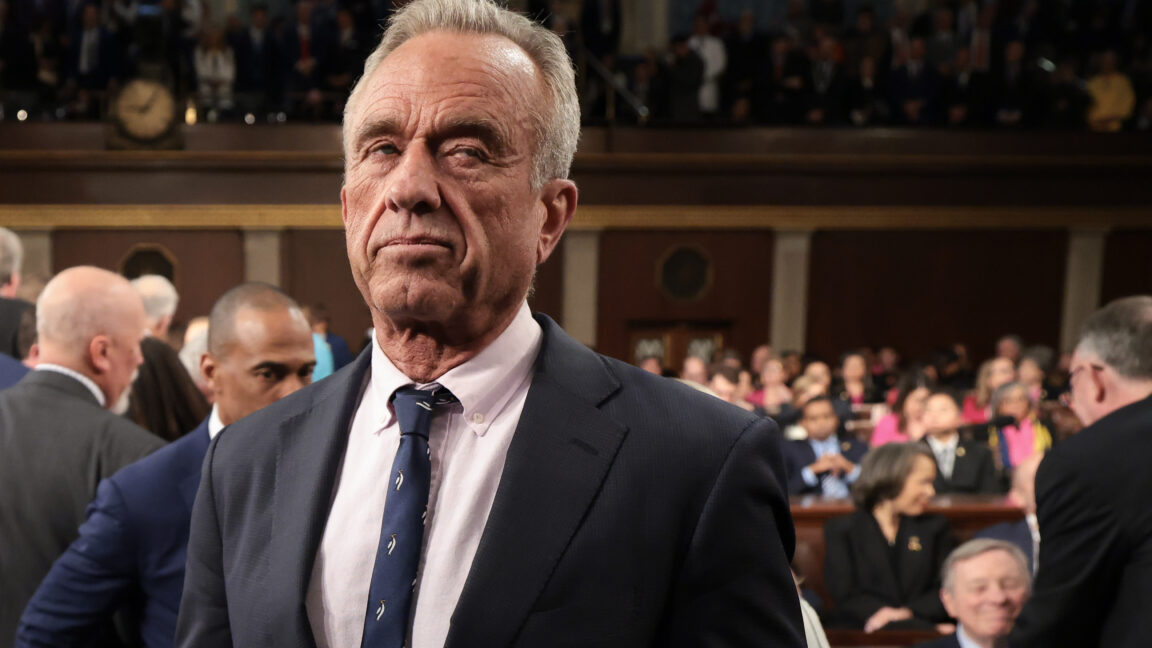
Senators are renewing calls for anti-vaccine Health Secretary Robert F. Kennedy to step down or be ousted—and at least one is calling for a criminal investigation—amid the release of documents they say prove Kennedy lied to them during his confirmation hearings last year.

"This is a pattern, not a slip," Sen. Edward J. Markey (D-Mass.) said in a statement. "RFK Jr. has lied to the Senate, lied to the American people, and jeopardized the health of children to advance his anti-vaccine agenda."

Sen. Ron Wyden (D-Ore.) said in a social media post Friday that the documents were "Proof we got RFK lying on the record during his confirmation hearing (a crime)." He called for the matter to be referred to the US Department of Justice for a criminal investigation. In a separate statement to The Guardian, Wyden added that "RFK's platform is built on lies and grifts that leave a trail of dead children in their wake. There are consequences for lying to Congress."

New documents

During Kennedy's reality-bending confirmation hearings in January 2025, multiple senators raised concern about a trip Kennedy took to Samoa in 2019. At the time, Kennedy was a prominent anti-vaccine activist leading the rabidly anti-vaccine organization Children's Health Defense (CHD). Just months after he visited the island nation, Samoa suffered a massive measles outbreak in which 83 people died, mostly children under the age of 5. The outbreak was largely fueled by a swell of vaccine hesitancy, drummed up by anti-vaccine activists. Vaccination rates had cratered to as low as 31 percent.

While the senators linked Kennedy's anti-vaccine work to that deadly measles outbreak, Kennedy denied any connection during the confirmation hearings. In an exchange with Wyden, Kennedy claimed: “I went there, [it had] nothing to do with vaccines. I went there to introduce a medical informatics system that would digitalize records in Samoa and make health delivery much more efficient."

In an exchange with Markey, he said: "My purpose in going down there had nothing to do with vaccines."

On Thursday, the Associated Press and The Guardian jointly released newly obtained documents that directly contradict Kennedy's statements. One of the documents is a letter Kennedy sent to Samoa's prime minister in January 2019, in which Kennedy falsely suggested "deaths associated recently with MMR [measles, mumps, and rubella] vaccines" were due to a bad lot of vaccinations from the manufacturer. Kennedy proposed letting him and his "team" from CHD investigate the country's MMR vaccines. In all, Kennedy used the words 'vaccination' and 'vaccine' eight times in the letter proposing his visit.

The prime minister responded with a letter in February saying he welcomed Kennedy and his "team's independent health assessment of our MMR vaccines." He requested Kennedy coordinate a visit with him.

What happened in Samoa

As Ars Technica reported in 2019, the deaths Kennedy was likely referring to in his letter were those of two infants, who died shortly after receiving MMR shots in July 2018. Officials determined that two nurses had mixed the vaccine with a lethal dose of muscle relaxant. One of the nurses tried to cover up the error by fishing the empty bottle of the muscle relaxant out of the garbage and taking it home. The two ultimately faced manslaughter charges and were both sentenced to five years in prison in August 2019.

In the meantime, CHD and other anti-vaccine activists pounced on the tragedy, claiming that the MMR vaccine was to blame. CHD spent months highlighting the deaths in Facebook posts and questioning the safety of MMR vaccines. They never updated the posts to include information about the nurses' fatal errors.

It was in this context that Kennedy visited Samoa in May and June of 2019, bringing a CHD member and his wife, actor Cheryl Hines, along with him. During the visit he was pictured with local anti-vaccine activists and staff members of the US embassy.

Samoa's deadly measles outbreak began in October. In November, an official with the World Health Organization directly tied to the outbreak to an anti-vaccine group stoking fear on social media, without directly naming CHD. The official said that the impact of the group "now being measured in the lives of children who have died in the course of this outbreak." Also in November, Kennedy sent the prime minister a four-page letter falsely claiming that the measles vaccine was to blame for the outbreak, writing erroneously that the MMR vaccine could spur "the evolution of more virulent measles strains."

With the release of the new letters yesterday, more lawmakers are speaking out against Kennedy and his anti-vaccine agenda. The documents land as the US itself is grappling with slipping vaccination rates and unbridled measles outbreaks, which have killed two people, including a newborn, this year. Kennedy has responded by spreading misinformation and downplaying the threat, as he has in the past.

Sen. Angela Alsobrooks (D-Md.) said Kennedy "must resign or be fired immediately." Hawaii Governor Josh Green, a doctor who responded to Samoa's measles outbreak, also renewed his call for Kennedy to immediately resign.

Read full article

Comments


Read the whole story
Share this story
Delete

Pentagon's Blacklisting of Anthropic Was Unlawful, US Judge Rules

1 Share
An anonymous reader quotes a report from The Guardian: A US judge ruled on Thursday that the Trump administration broke the law when it designated Anthropic as a supply chain risk earlier this year, finding that the government had unlawfully targeted the AI firm for refusing to comply with defense department demands. "The empty invocation of national security is not a blank check to punish and retaliate against government critics," Judge Rita Lin said in a 59-page decision. Lin's ruling barred the federal agencies named in the lawsuit from enforcing Donald Trump's order to stop using Anthropic's tools and overturned the designation of the company as a "supply chain risk" by the defense secretary, Pete Hegseth. The status, usually reserved for foreign firms, would have blocked government agencies from doing business with Anthropic. The case emerged out of a months-long feud between Anthropic and the Pentagon at the start of the year. Anthropic refused to allow the government to use its Claude AI model for fully autonomous lethal weapons or domestic mass surveillance, resulting in Hegseth accusing the company of "arrogance and betrayal". Lin put a temporary pause on the government's punitive measures in March, stating that the government's actions looked like an attempt to "cripple Anthropic" for exercising its first amendment rights. The ruling this week makes that temporary suspension permanent, although the government may appeal. "We welcome the court's ruling that this supply chain risk designation was unlawful," an Anthropic spokesperson said.

Read more of this story at Slashdot.

Read the whole story
Share this story
Delete

World humanoid robot games show runners breaking records, bursting into flames

1 Share

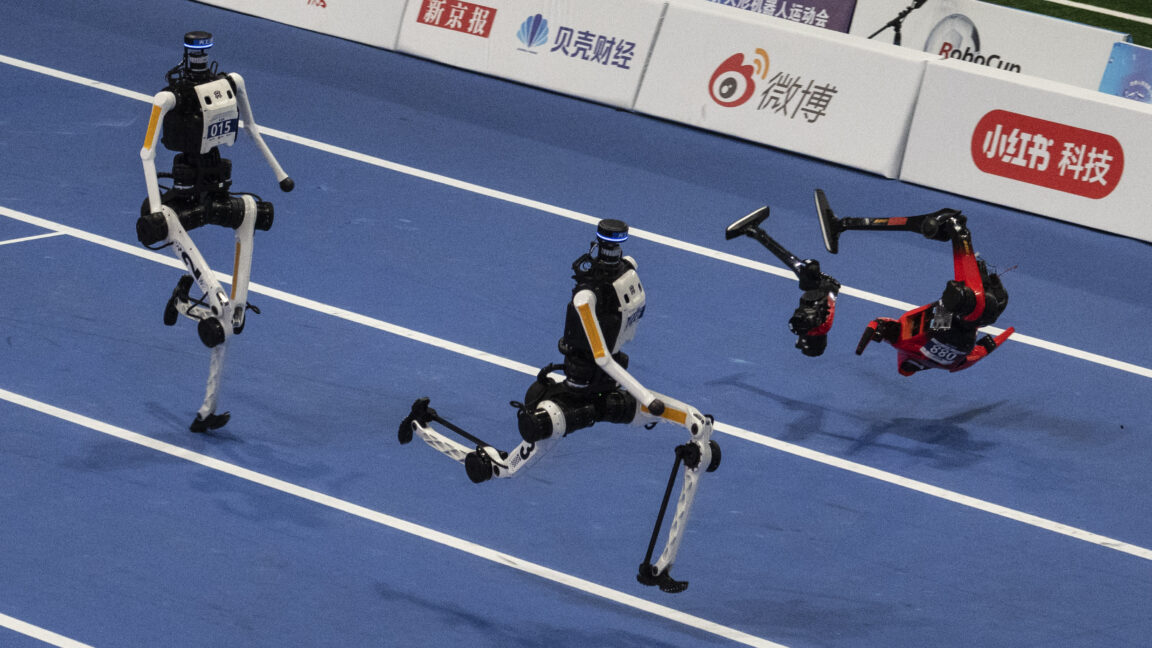
Viral videos of the World Humanoid Robot Games show sprinting robots beating the human 100-meter record held by Usain Bolt—but also feature running robots crashing into barriers and falling down because they cannot readily stop running. A few fallen robots even break at the waist in a shower of sparks or catch on fire.

That demonstration of both robotic prowess and limitations came from the second edition of the World Humanoid Robot Games hosted in Beijing from August 22–26. Like the inaugural event held in 2025, this year’s event challenged humanoid robots to run fast, perform kung fu or dance moves, fight one another in kickboxing, and play soccer or table tennis.

This year’s games also tested robots in more humdrum practical scenarios like washing and hanging laundry, where they appeared to lag behind typical human working speeds. That suggests the event organizers, including Chinese state media and the Beijing city government, are keen to showcase the commercial potential of humanoid robots at a time when China’s robotics industry is rapidly developing and testing such robots.

Endless runner

The fact that humanoid robots went from lagging behind human record-holders last year to surpassing human world records in the 100-meter sprint and standing high jump events this year suggests significant progress in robotic whole-body control for accomplishing specific tasks, Dipam Patel, a PhD candidate in computer science at Purdue University and a research assistant at the US Army DevCom Army Research Lab, told Ars.

“All of that does display whole body control, because you need to move all the joints, hands, legs, arm, body, everything to accomplish that task,” said Patel, who is also a graduate student member of IEEE. “So there has definitely been a huge push in engineering from where they were last time to this time.”

However, the robots on display in the World Humanoid Robot Games are still very far from general-purpose autonomous robots capable of handling practically any task. Instead, these robots were engineered to accomplish just one task, as shown by the fact that the running robots sprinted in a straight line and could not even slow down by continuing around the track after the finish line.

“If you cross the finish line, that's the goal—it doesn't matter if you stop and it doesn't matter if you fall into different pieces,” Patel told Ars. “Some companies had different types of robots for different games or different tasks, because they were engineered for that task to be the best in that.”

Humanoid robot stumbles.

The robotic races and other flashy events provide for an entertaining spectacle that can lead to easy news headlines and viral video clips. They also give robotics companies an opportunity to attract more publicity and investor money by potentially standing out from the competition, Patel said.

One type of humanoid robot developed by the Beijing-based company X-Humanoid gained viral online fame for winning the small-group 400-meter race with an unusual “shy person hiding behind their hands” posture. The robot’s developers told the Global Times that the robot learned through reinforcement learning trials in simulation to shift from a human-style runner’s arm swing to holding its arms up near its face and swinging them back and forth through hip rotations.

Measures of robotic progress at the games could prove even more meaningful if, for example, they challenged robots to run the same race 10 times, Patel suggested. That would require the robots to demonstrate they have the software and hardware to perform reliably over multiple trials—and maybe even learn to slow down safely without endangering themselves or any bystanders.

Boring is more useful

The less flashy events that debuted during the World Humanoid Robot Games this year may ultimately prove more useful benchmarks for robotic progress. Such scenario competitions included household chores, like washing laundry, folding clothes, and cleaning up living rooms, according to the Chinese state media publication the Global Times.

Robots were also challenged by an unscheduled interruption when they had to bring a delivery package inside. That required them to switch tasks from the household chores to deal with receiving the delivery.

The Beijing Continental Grand Hotel provided robots with a different set of timed challenges, including moving wheeled luggage to assigned hotel rooms, cleaning up beds and restocking supplies. The Global Times also reported that a separate library shelving event challenged robots to collect book returns and put them in the correct place as a test of visual recognition and reasoning.

One of the livelier practical scenarios involved an outdoor firefighting and rescue event. Robots had 30 minutes to identify hazardous substances, locate and shut off three open valves of different types, spot a fire, and then find a fire extinguisher to put it out. Only three out of 12 competing robot teams completed the entire challenge, according to the Global Times.

Robots even participated in six events challenging hand dexterity, including picking up beans and driving screws. They also competed to precisely hammer nails into a corkboard without driving them in at an angle.

But Patel observed that many of the robotic competitors were still being teleoperated by human operators who directly controlled the robots’ actions. The World Humanoid Robot Games allowed for human teleoperation of robots in certain events, but penalized the final score if robots were being remotely controlled rather than performing autonomously.

Limits of robot autonomy

The fact that many events still permitted humans to directly control robotic motions shows that autonomous robot systems still have a long way to go, Patel said. Whereas humans can quickly learn many tasks on the fly, robots require much more training through repeated trial-and-error attempts either in simulation or in real-world scenarios.

“You need to have all possible edge cases for a robot to learn from interaction, which is not really feasible,” Patel told Ars. “You can simulate something like 100,000 scenarios for hammering a nail, but that’s just one task from millions of tasks in the world.”

The AI models powering many robots can also learn from huge amounts of visual data involving human demonstrations. But gathering such task demonstration data for robots has proven time- and resource-intensive, despite various companies’ efforts to pay ordinary people to strap cameras on their heads.

“We would have to push the algorithmic development a lot to actually see a robot being able to generalize and do eight-hour work shifts in any random environment,” Patel explained.

Even the more autonomous robots competing in the World Humanoid Robot Competition still rely heavily on cloud computing to help run intensive AI models, rather than running the AI computing directly on their own onboard hardware, according to the South China Morning Post. It described robots being equipped with 5G modules to transmit data to an “embodied-intelligence system” and then receiving instructions on what to do next.

The real test for humanoid robots’ capabilities will necessarily take place in the real world beyond the demonstrations at the World Humanoid Robot Games. Investors have poured more than $6 billion into humanoid robot companies in 2025 alone, with Chinese companies being especially aggressive in testing and deploying such robots.

Meanwhile, US companies like Boston Dynamics and Agility Robotics are also ramping up their own commercialization and deployment plans in factories and warehouses. The US government has even banned the import of foreign-made robots, including China’s most popular humanoid robots.

But not all robotics researchers are convinced that humanoid robots are necessary, especially when the most useful robots currently doing productive work usually come in other shapes and sizes. For his own part, Patel is focused on developing software algorithms that allow many different types of robots to seamlessly switch between tasks.

Read full article

Comments


Read the whole story
Share this story
Delete

Catholic bishops tell Florida there's no religious reason for vaccine exemptions

2 Shares

Florida's attorney general got a fiery rebuke and some ecclesiastical schooling from the state's Catholic bishops after he boldly threatened to block funding to Catholic schools unless the church bends to the state's ant-vaccine policies—policies allegedly intended to uphold religious freedom.

On July 31, Attorney General James Uthmeier sent a questionable letter to the bishops regarding exemptions to school vaccination requirements. Florida law requires public and private schools to allow vaccination exemptions based on religious grounds. But Catholic schools in the state do not accept religious exemptions; Florida's Catholic dioceses support vaccination and recognize no theological argument against it. The schools only accept exemptions based on medical conditions that are verified by a healthcare provider.

Uthmeier, himself a Catholic, wrote to the bishops in an open letter that, based on his own understanding of Catholicism, he saw "no legitimate religious reason to refuse granting religious exemptions." He reviewed select theological positions regarding the use of "abortion-derived vaccines," and suggested to the bishops that it was "morally reprehensible" that they not grant religious exemptions.

Beyond sharing his personal interpretations with the bishops, Uthmeier threatened to withhold state scholarships and vouchers from Catholic school if they don't change their position.

"Far from hallow"

The bishops responded with their own letter, which they made public last week. With a firm crack, they smack down Uthmeier's legal and theological arguments, while also noting that they're being unnecessarily nice in explaining to him why he's wrong. "[T]he Catholic bishops in Florida do not have to justify to your office their position on Catholic teaching and their reasons for the current vaccine policies," the write.

But "out of respect," they go on to demolish Uthmeier's points, citing the hierarchical nature of the Catholic church, the Religion clauses of the First Amendment, state laws, and previous court rulings. In all, "It is beyond cavil that the bishops, not the state, decide how to interpret and apply Catholic principles and theology."

They write:

The constitutional defect in your office’s inquiry is, therefore, not merely the conclusion it posits, but the inquiry itself. Whether Catholic doctrine requires, permits, or disfavors a particular exemption is a religious question entrusted to Catholic authorities, not state officials. The government may not decide that Church teaching is insufficiently religious, insufficiently consistent with Catholic doctrine, or insufficiently compelling to justify an ecclesiastical policy. Nor may it require Church leaders to defend their interpretation of Catholic doctrine before civil authorities as a condition of operating religious schools.

To the threat of withholding educational scholarships and other funding, the bishops call it "far from hallow and legally incorrect."

"The state cannot disqualify Catholic schools from the scholarship program merely because a state official’s views differ from the bishops' views."

Vaccine and the common good

As to their position on vaccines, the bishops explain their policy by first addressing a common religion-tinged criticism of vaccines: that the production of some of them involves using cell cultures that were originally developed from fetuses aborted in the 1960s. With the cell lines still in use, no new fetal cells or abortions are involved, and vaccines are purified so that no fetal tissue is in immunizations.

Some, like Uthmeier, claim that use of such vaccines goes against the church's belief in the sanctity of life. But, in fact, the church has repeatedly made clear that this is not the case. The Florida bishops reference a 2017 document from the Pontifical Academy for Life and the Italian Bishops’ Conference that getting vaccinated "does not signify some sort of cooperation with voluntary abortion" and can be done "with a clear conscience." The Florida bishops further clarify that it is "morally permissible" for parents to have their children vaccinated for the same reason.

The bishops say that some parents may still disagree, and for those parents, they "are free to choose a different educational path for their children. Catholic virtual schooling and home schooling are among them," the bishops write.

Their vaccine policy is "rooted in the desire to protect the common good and to encourage the proportional benefits of utilizing vaccines," the bishops write. "This position is rooted in our Catechism: 'Life and physical health are precious gifts entrusted to us by God. We must take reasonable care of them, taking into account the needs of others and the common good.'"

The bishops note the vaccines not only protect healthy children, but also vulnerable groups in their schools, including children who cannot be vaccinated due to medical conditions, expectant teachers, and elderly parents and grandparents.

State context

The bishops' stand against Uthmeier comes as Florida's Republican leaders continue to attack life-saving vaccines and vaccination requirements. Last year, Florida Surgeon General Joseph Ladapo announced that the state planned to end all vaccination requirements, including those for school children. He dramatically claimed that every vaccine requirement "drips with disdain and slavery."

On Monday, the state proposed a rule to remove requirements that children get vaccinated against chickenpox, hepatitis B, Haemophilus influenzae type B, and pneumococcal to enter school. The rule would also expand religious exemptions.

The bishops' letter highlights a fallacy often used by anti-vaccine advocates: that undermining vaccines and dismantling vaccination requirements upholds religious freedom, when in fact it can be an attack on that freedom. Just on Monday, anti-vaccine Health Secretary Robert F. Kennedy Jr. proposed weakening the wording of federal vaccine recommendations "in favor of individual autonomy and religious freedom." Yet, no major religion in the world forbids vaccinations, and most encourage and embrace them as a common good, like the Catholic bishops.

The bishops ended their letter noting that they periodically review their vaccine policy. But, they wrote, they stand firm in their rejection of religious exemptions and "will not succumb to affronts to religious freedom."

Read full article

Comments


Read the whole story
Share this story
Delete

AI is hitting entry-level jobs hardest, Stanford study finds

1 Share

For years, AI industry watchers of all stripes have been warning of a coming jobs apocalypse driven by ultra-intelligent AI systems that will be able to replicate most human tasks more cheaply. Now, newly updated research from Stanford University economists suggests AI seems to be causing significant entry-level job losses for younger workers in some fields, even as older workers appear largely unaffected so far.

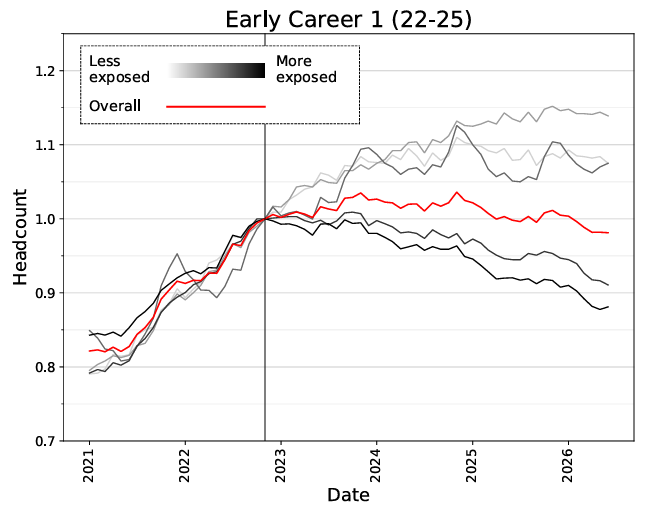
The August 2026 edition of "Canaries in the Coal Mine? Six Facts about the Recent Employment Effects of Artificial Intelligence" updates and revises a paper of the same name published last year with fresh data and refined statistics. In that update, the Stanford researchers find the employment trends they identified for entry-level workers last year are persisting and expanding. Specifically, employment levels for workers ages 22 to 25 in the most "AI-exposed" occupations are now 19 percent below those of their peers in fields less exposed to AI disruption.

Last year, that gap measured just 13 percent.

Not all jobs are AI jobs

To determine those numbers, the researchers used a large subsample of the anonymized, high-frequency payroll data regularly aggregated by HR management company ADP. The team then rated each occupation's "exposure" to AI disruption using both a potential labor market impact gauge established by previous researchers (we took a somewhat critical look at that previous research earlier this year) and the Anthropic Economic Index, which looks at how various occupations actually use the Claude model in their everyday work (Google released a similar report based on occupational Gemini usage last month).

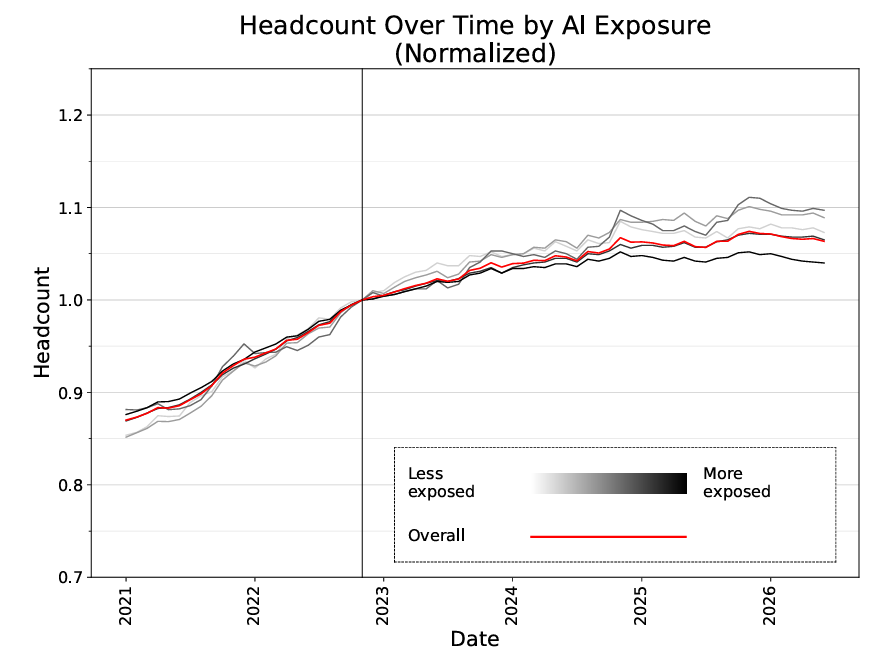
When crunching the numbers economy-wide, the researchers found little to no difference in relative overall employment between the jobs judged most and least affected by AI on these metrics. When separating out workers ages 22 to 25, though, the researchers found that, since 2022, employment in the top 40 percent of "AI-impacted" jobs had fallen by about 11 percent. In the 60 percent of jobs with the least AI impact, by contrast, total employment for those young workers grew by 10 percent over the same period.

Across the entire economy, relative employment effects in more heavily AI-impacted fields are relatively muted. Credit: Brynjolfsson et al
For entry-level workers, though, there is a large and widening gap between employment in fields that are or are not impacted by AI. Credit: Brynjolfsson et al

Digging deeper into the data, the researchers found that this phenomenon is mainly manifesting itself through lower hiring rates for entry-level workers in AI-impacted fields, rather than increased firings or employees quitting. They also found that the labor market effects among this age group were mostly seen in lower overall employment, rather than reduced pay rates.

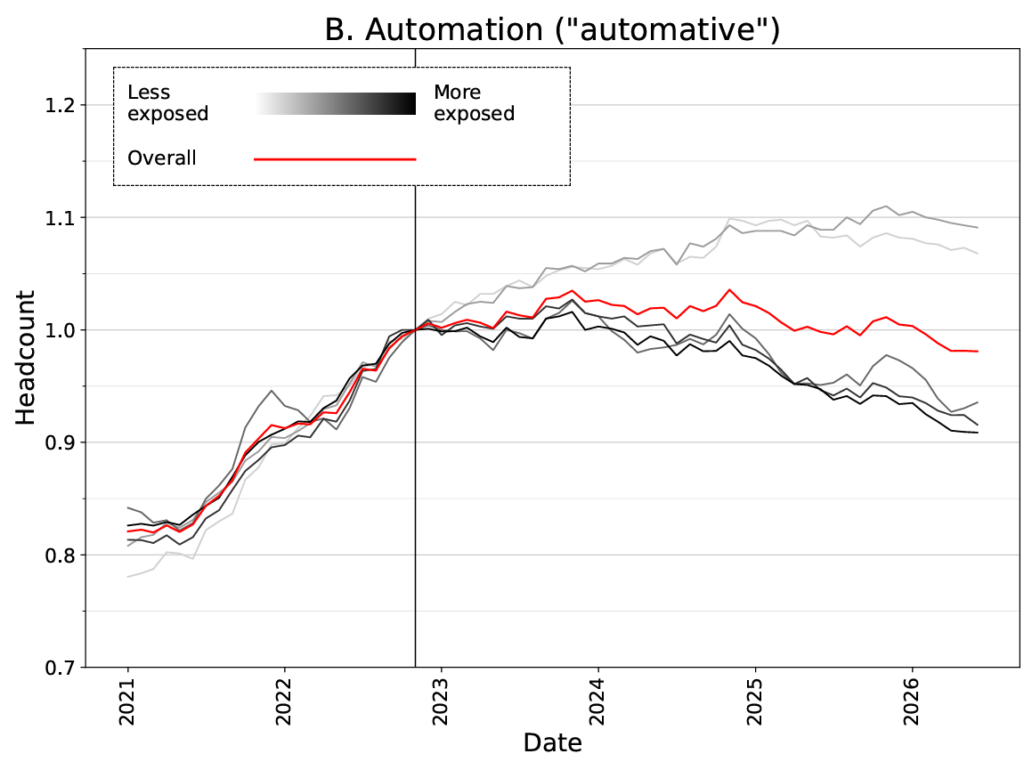
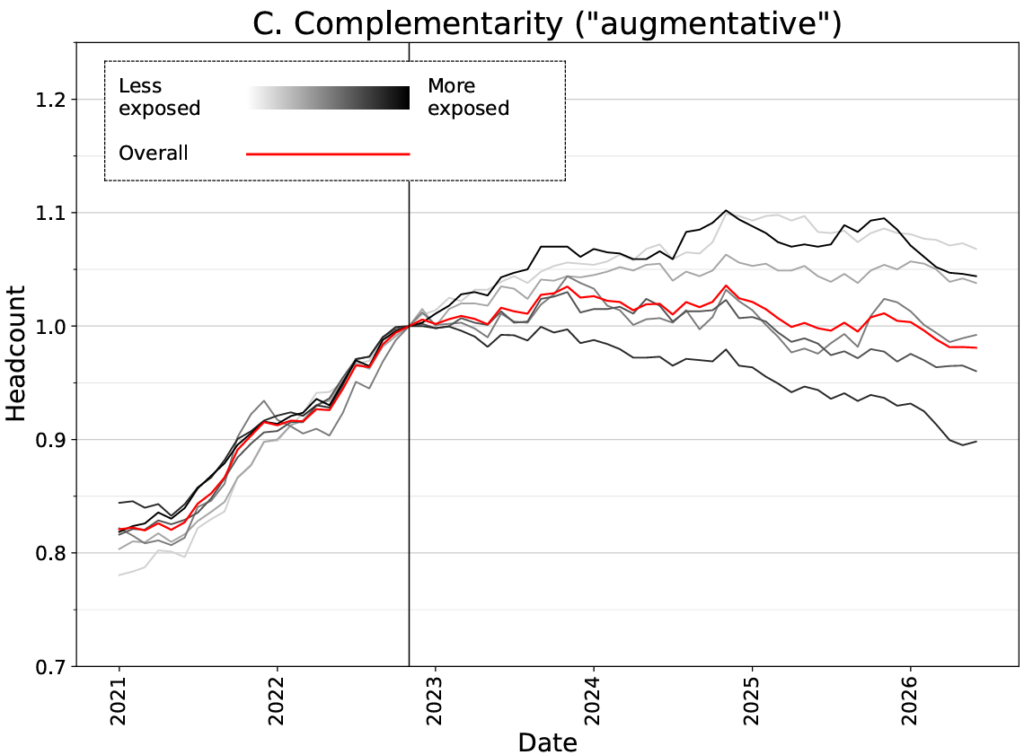
But not all jobs that show potential for AI "disruption" are created equal, the researchers found. In its Economic Index, Anthropic differentiates between queries related to tasks that are "automative" (i.e., fully replacing work previously done by a human) or "augmentative" (i.e., helping human workers be more effective at tasks they are still needed for). By this measure, jobs like "accountants and auditors" and "receptionists and information clerks" were among those judged most susceptible to AI automation, while jobs like "chief executive" and "registered nurse" were among those using AI augmentation most often.

Unsurprisingly, jobs where AI automation is prevalent are the ones showing the worst relative employment levels for entry-level workers these days. "The findings are consistent with automation-oriented uses of AI substituting for labor while complementary uses are associated with flat or rising employment," the researchers write.

For 22-25 year olds, jobs where "automative" users of AI are especially prevalent show heavily declining entry level employment rates. Credit: Brynjolfsson et al
For jobs where AI is merely "augmentative," the entry level jobs picture is much more muddled. Credit: Brynjolfsson et al

Stay in school, kids

The researchers also theorized that entry-level workers could be especially affected by AI's impact on jobs that require heavily "codified" knowledge—the kind of "formal, standardized, documented knowledge that can be taught through education, textbooks, or written procedures." That would contrast with jobs where AI mainly complements an experienced worker's more "tacit" knowledge, which is overwhelmingly "acquired through practice, mentorship, and repeated exposure to real situations," the researchers write.

To test this hypothesis, the researchers used the required level of formal education in O*NET's extensive occupational database as a proxy for how reliant that job is on codified knowledge. Breaking out the employment data, the researchers found that "occupations with higher codified knowledge have slower entry-level employment growth, while occupations with higher tacit knowledge have faster employment growth for mid-career and senior workers."

At the same time, the researchers found that higher education might still serve as a buffer against the employment effects the Stanford researchers identified. As they write, occupations with a higher share of college graduates showed more "muted differences between more-exposed and less-exposed occupations" regarding AI. In jobs with few college graduates, on the other hand, "the least AI-exposed occupations [saw jobs] growing and the most exposed occupations [were] declining in employment."

In a recent interview with The Washington Post, lead researcher Erik Brynjolfsson warns that the current trends suggest a near future in which jobs for those employed in the pre-AI era largely persist, while many jobs for the incoming working-age cohort start disappearing. "The entry-level effects we’re measuring are real, persistent and widening," he said, "and I’m more worried than I was about a labor market that keeps its overall employment level while quietly closing the on-ramp for people starting their careers."

Read full article

Comments


Read the whole story
Share this story
Delete
Next Page of Stories